
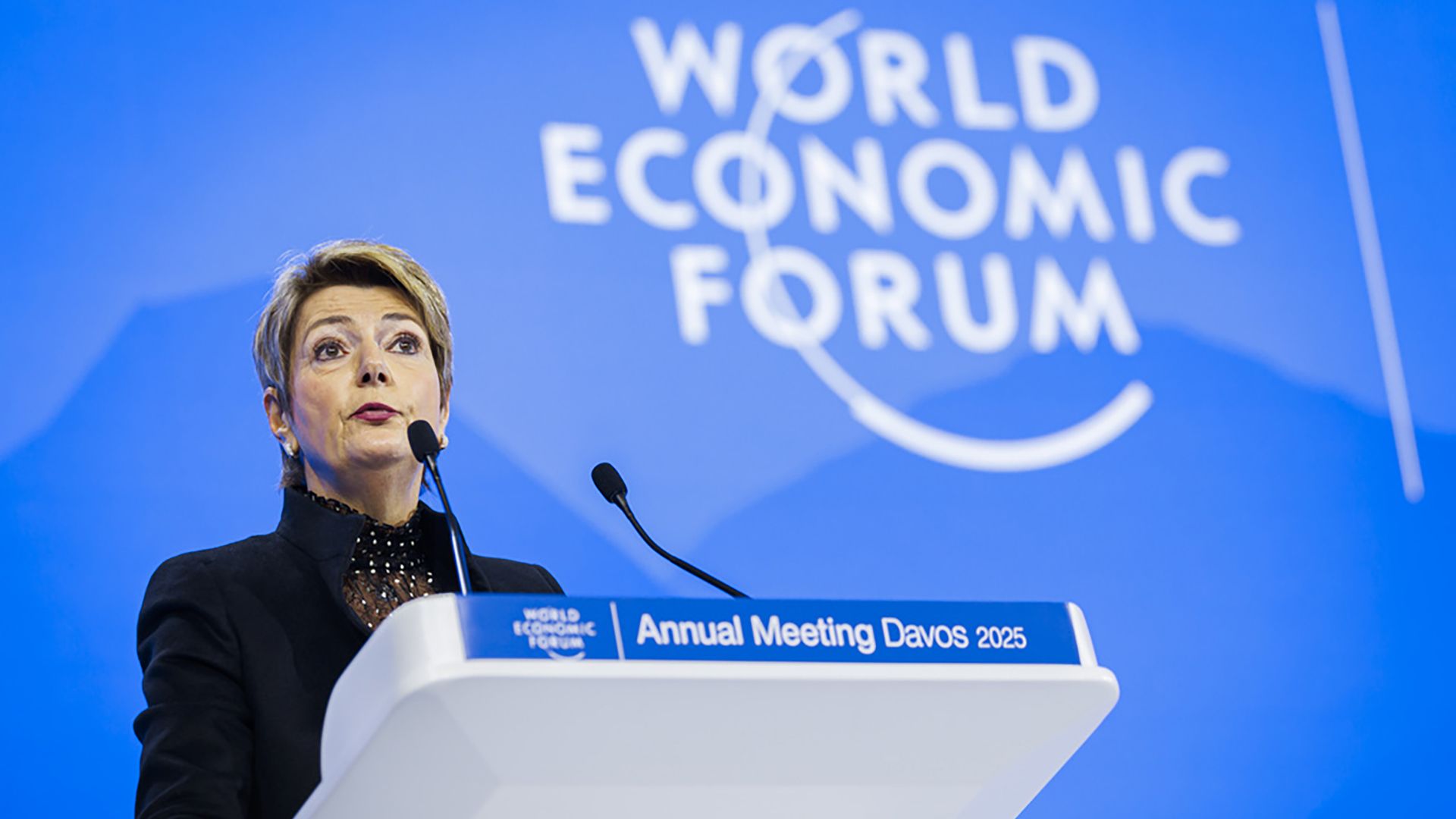
Opening address by President Karin Keller-Sutter
2025 Annual Meeting of the World Economic Forum in Davos
Check against delivery
Professor Schwab
Excellencies
Ladies and gentlemen
Perhaps it would send a shiver down your spine here in wintry Davos if I were to ask you for reasons to be cheerful in these times. But don’t worry, you won’t have to rack your brains – I’ll give you a pretty good reason myself: the prosperity of nations and their populations is not simply left to chance. No, there are rules and patterns that can be recognised. These scientifically based findings earned Daron Acemoglu, Simon Johnson and James Robinson the Nobel Prize in Economics last year.
They show that countries that establish community-oriented institutions to protect citizens’ rights and promote fair competition are more likely to prosper in the long term. Where power and resources are concentrated in the hands of a small elite, however, widespread prosperity and social peace cannot flourish. In these turbulent times, insights such as these serve as a signpost, pointing the way forward and making a strong case for democratic and liberal values.
Excellencies
Ladies and gentlemen
Signposts are particularly useful these days. The British magazine The Economist once aptly described our time as the «era of predictable unpredictability». When certainties fade away and you must always be prepared for surprises, it is important to create reliability wherever possible.
Responsibility lies primarily with governments. They must ensure that the right conditions are in place – at both the national and international level. Let me start – also in the spirit of the Nobel laureates I mentioned – with the general conditions that a country must primarily create on its own. After all, the international community also benefits from the domestic strength and thus the prosperity and stability of individual states. It can ultimately only be as strong as the sum of its members.
Firstly, I would like to mention the institutional dimension. Only a state with stable institutions can create a sound environment where everyone can freely develop their potential, and a state must protect this freedom with rules. Within this secure framework, the economy and its businesses can generate prosperity.
Secondly: competitiveness, both domestically and with the world. Without competition there is no innovation, and without innovation there is no progress. Think of climate change – it will be impossible to deal with it without technological progress. But in order for the best ideas to serve everyone, we need open production and goods markets. And these markets only work if we ensure fair and transparent rules. The free trade in goods and services has reduced poverty in many parts of the world and made humanity as a whole more prosperous. It would be wrong to forget this. Of course, there is potential for improvement. Many people feel forgotten in the globalised world. This has a negative impact on the credibility of national and international institutions. This is another, but not purely economic reason, why Switzerland will continue to advocate for open and regulated trade.
The third point I would like to mention is fiscal strength. The importance of healthy public finances is immeasurable, especially in unstable times. They make a state strong and resilient to crises. They enable it to invest not only in education and infrastructure, but also in security. In social security, and of course – especially in times like these – also in national security. A state is only credible and sovereign if it has sufficient resources and if it can guarantee its core task of providing security. At the same time a state’s ability to act is also its best defence against populist tendencies.
As I said at the beginning, the concentration of power and resources in the hands of just a small elite can be an obstacle to widespread prosperity and social peace. The same also applies when politicians squander the working population’s money without any discernible benefit. Or if they borrow and spend at the expense of future generations. I’m sure I’m not the only one in this room who is concerned about the very high and rising debt levels in many countries. They not only pose a risk for those countries, but also a threat to the stability of the international financial markets.
As finance minister, I have been dealing with this topic intensively for some time now. No market is more globalised than the financial market. Financial market stability can therefore only be achieved multilaterally. When Credit Suisse failed, Switzerland was able to prevent the loss of confidence in a single bank from spiralling into an international financial crisis. Switzerland was able to act because it has stable institutions, is financially strong and could guarantee large sums. But it was a close call, and I believe a stronger international regulatory framework is essential.
Excellencies
Ladies and gentlemen
Switzerland is willing to do its homework and maintain its domestic strength and sovereignty. This also allows us to be involved at the international level and to stand up for global interests in a spirit of solidarity. For this solidarity to work, we need international agreements that are adhered to. With this in mind, Switzerland is committed to a just and lasting peace in Ukraine and to the country’s long-term reconstruction. And with regard to the Middle East, Switzerland welcomes the ceasefire in Gaza and commends the negotiating efforts of the United States, Egypt and Qatar.
But it is not only for government to assume responsibility, business must do so too – for itself, for expertise-building training, for the environment, and for society. There is, to put it diplomatically, still room for improvement. For some years now, we have been able to observe how economic players increasingly call for state support, in short: for public money. The pandemic reinforced this tendency. Excessive wages also undermine trust in the private sector. As a result, due to such failures, the considerable social and ecological commitment of so many companies, from small businesses to global corporations, risks being forgotten. So let me ask you to help restore the positive image of the business community. In return, I can assure you of Switzerland’s commitment to safeguarding reliable conditions at the national and international level.
Excellencies
Ladies and gentlemen
These are not good times for people without an inner compass, for routes without signposts. Davos in winter is also not a good place for shoes without a sturdy tread. So don’t slip! And above all, let’s make sure we don’t slip up!
Thank you!
Federal Councillor Karin Keller-Sutter

Biography
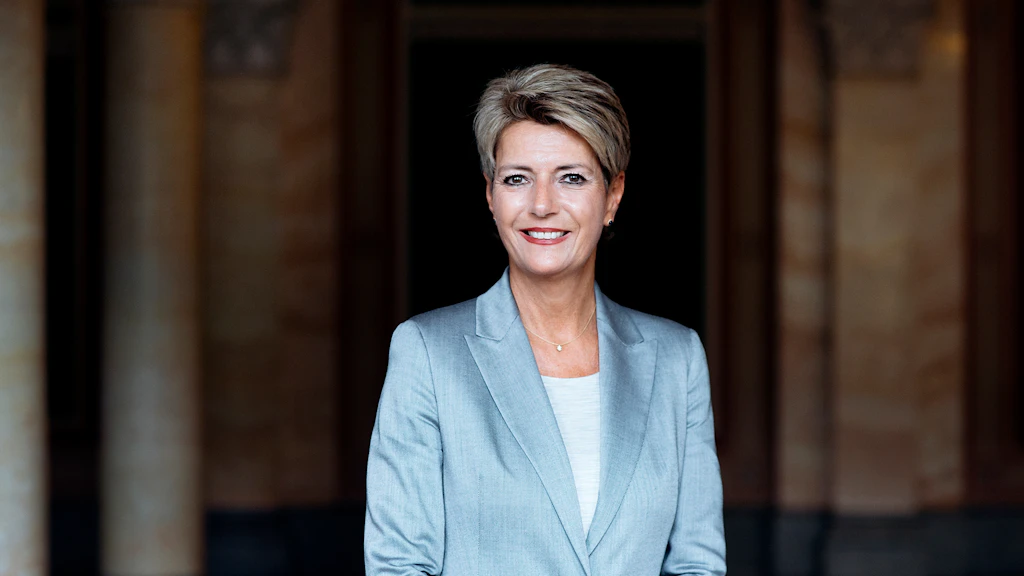
Federal Councillor Karin Keller-Sutter has been Head of the Federal Department of Finance FDF since January 2023.
Autograph card
Order an autographed card from the Federal Councillor.

Interviews and articles
A selection of interviews with Federal Councillor Karin Keller-Sutter.

Speeches
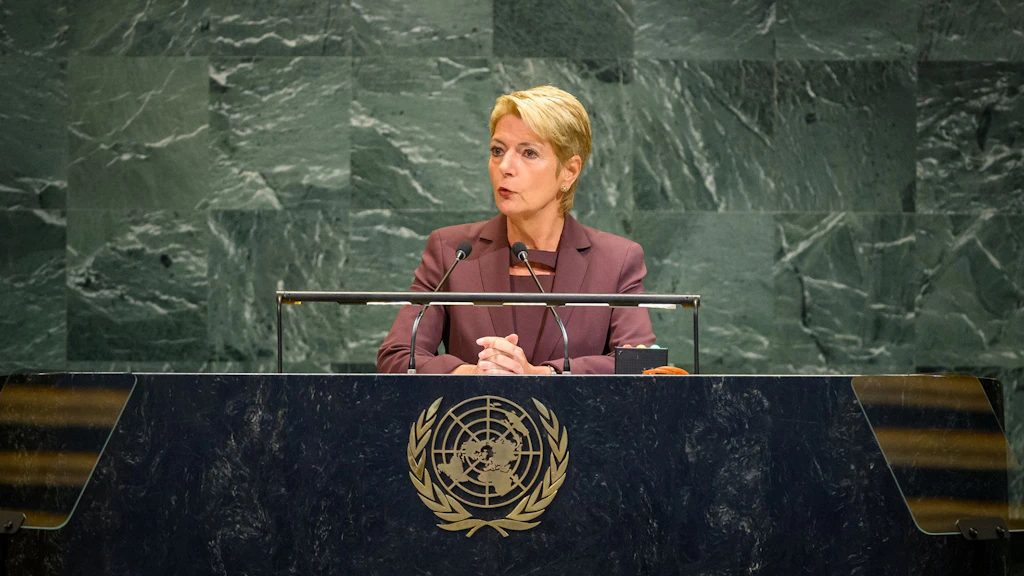
Speeches by Federal Councillor Karin Keller-Sutter in full.
Presidential year 2025
Highlights of Federal Councillor Karin Keller-Sutter's presidential year.