

Federal debt
Switzerland's level of debt is low by international standards. But how high is the federal debt and what is its composition?
Brief summary
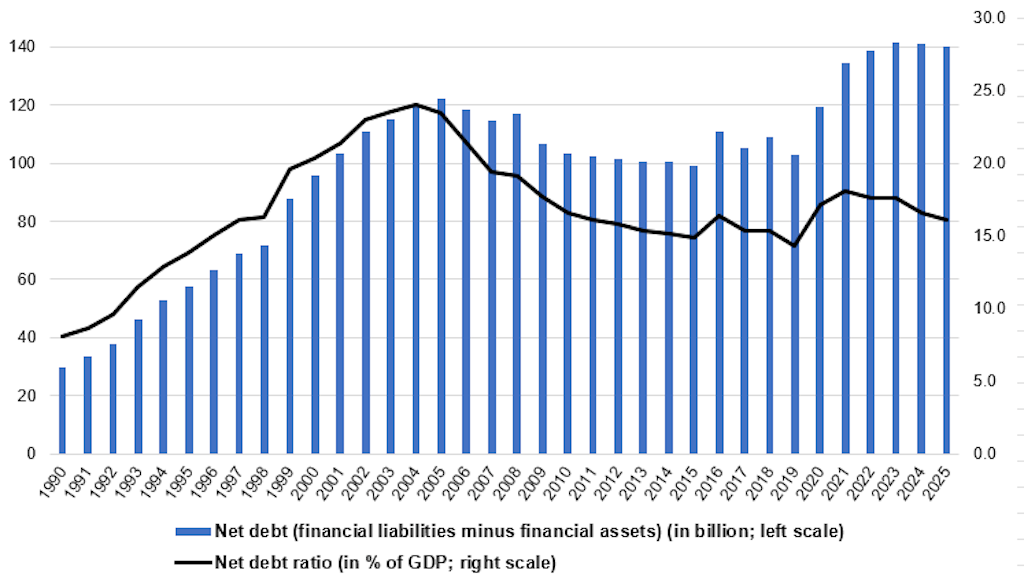
Net federal debt stood at CHF 140 billion at the end of 2025, which corresponds to a debt ratio of 16.1% of GDP.
Switzerland's level of debt is low by international standards. The Confederation has the debt brake to thank for this. Following its introduction in 2003, it has allowed for a considerable reduction in federal debt. However, debt rose sharply again between 2020 and 2022 as a result of the COVID-19 pandemic. The Confederation made around CHF 35 billion available to cushion the impact on the economy and healthcare.
The coronavirus-related debt is reflected in the shortfall in the amortisation account. This shortfall, made up of extraordinary expenditure less extraordinary receipts, amounted to CHF 26.3 billion at the end of 2025 and must be eliminated in accordance with the Financial Budget Act (FBA). Parliament chose to adhere to this complete elimination, but extended the timeframe for doing so until 2035 (with an option for a further extension to 2039). Future structural financing surpluses in the ordinary budget and extraordinary receipts arising from the profit distribution by the Swiss National Bank can be used to reduce debt.
What is the composition of federal debt?
Around CHF 87 billion of the debt is money and capital market debt. The Confederation's net debt also includes other liabilities, such as outstanding payments vis-à-vis taxpayers, cantons or federal enterprises. Net debt consists of total liabilities less non-administrative assets.
How does the Confederation take on debt?
In order to raise borrowed capital, the Confederation issues debt instruments, so-called Confederation bonds and money market debt register claims. These debt instruments are securities and, like other securities, can be freely traded by the holders during the term.
- Money market debt register claims are short-term borrowings, i.e. loans, mostly with a term of three months and a maximum of 12 months.
- Confederation bonds guarantee more long-term borrowing and have maturities of up to 50 years.
The Confederation pays a price for its debt, i.e. debt interest. This totalled CHF 1.02 billion in 2025.
From whom does the federal government borrow?
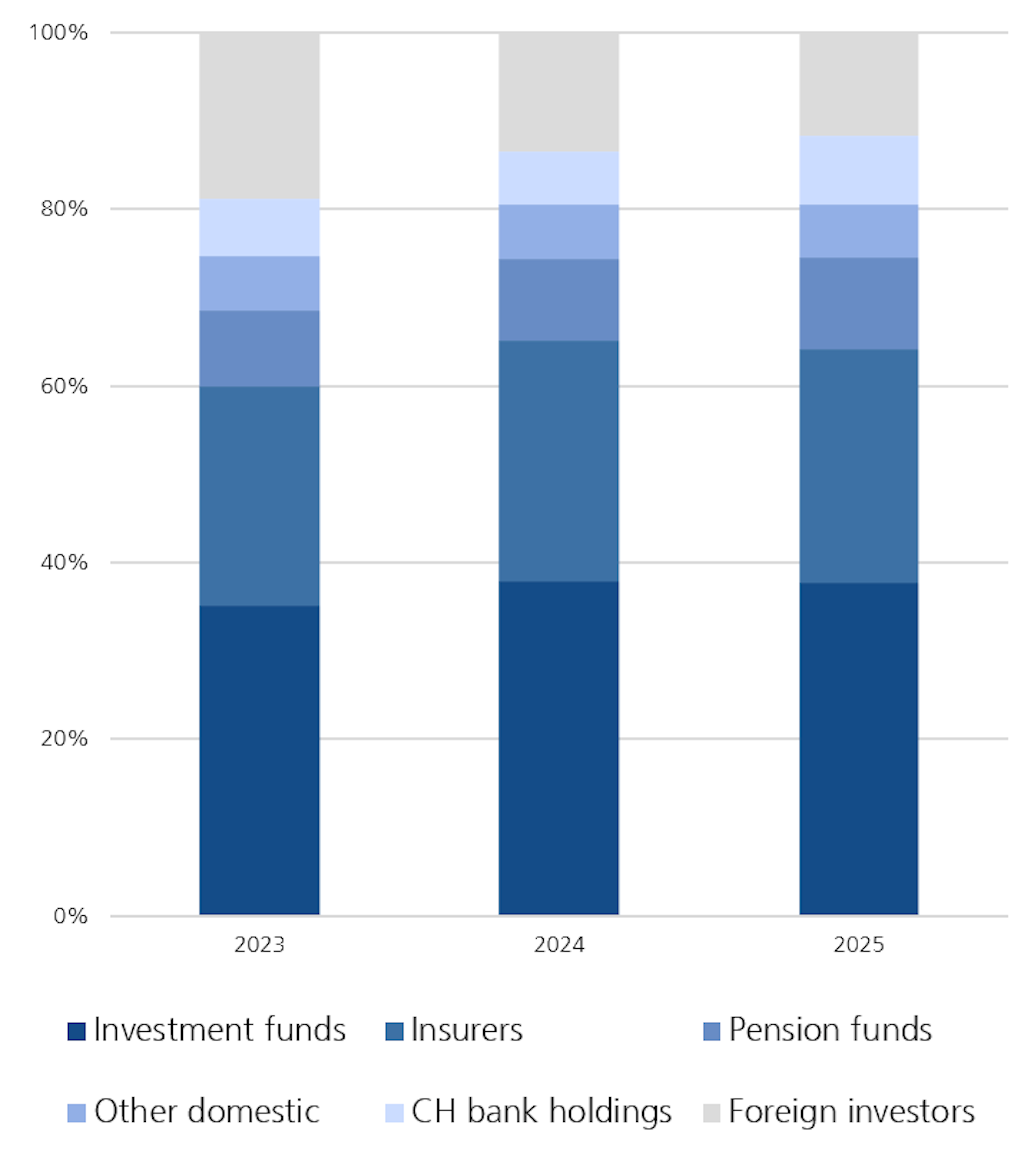
As the money market and capital market instruments issued are traded and the name of the holder is not registered, the federal government does not know exactly who holds them. However, the Swiss National Bank's statistics give an indication of the likely composition of the Confederation bond investor base: domestic investment funds and insurance companies account for a large proportion, foreign investors represent around 12%, and the remainder is shared by pension funds, banks and other domestic investors. Consequently, most of the federal debt is owed to domestic institutional investors.
Press releases on the topic
FDF and SNB enter into new profit distribution agreement. Agreement covers financial years 2026 to 2030
The Federal Department of Finance (FDF) and the Swiss National Bank have signed an agreement on the SNB’s profit distributions for the years 2026 to 2030. The modalities remain unchanged. Provided that the SNB’s financial situation permits, an amount of up to CHF 6 billion per annum will be distributed to the Confederation and the cantons.
Publication notice: The FFA publishes the financial statistics for 2025
The general government, comprising the Confederation, cantons, municipalities and social security schemes, is expected to generate a financing surplus of around CHF 4 billion in 2025. The general government's gross debt, as defined by the International Monetary Fund (IMF), is expected to rise by around CHF 5.4 billion to CHF 353.2 billion in 2025 (40.7% of GDP).This is shown in the latest financial statistics figures, which are available on the website of the Federal Finance Administration:Main aggregatesDetailed FS data (financial statistics, for national comparability)Detailed GFS data (Government Finance Statistics, based on the IMF standard)International comparison
Publication of state financial statements for 2025
As of 23 March 2026, the state financial statements for 2025 are available in electronic format on the website of the Federal Finance Administration (FFA). The figures are also available in the federal budget data portal. The hard copy will be released on 14 April 2026. The Federal Treasury activity report is published to complement the state financial statements.
Federal Finance Administration FFA
Switzerland - 3003 Bern